

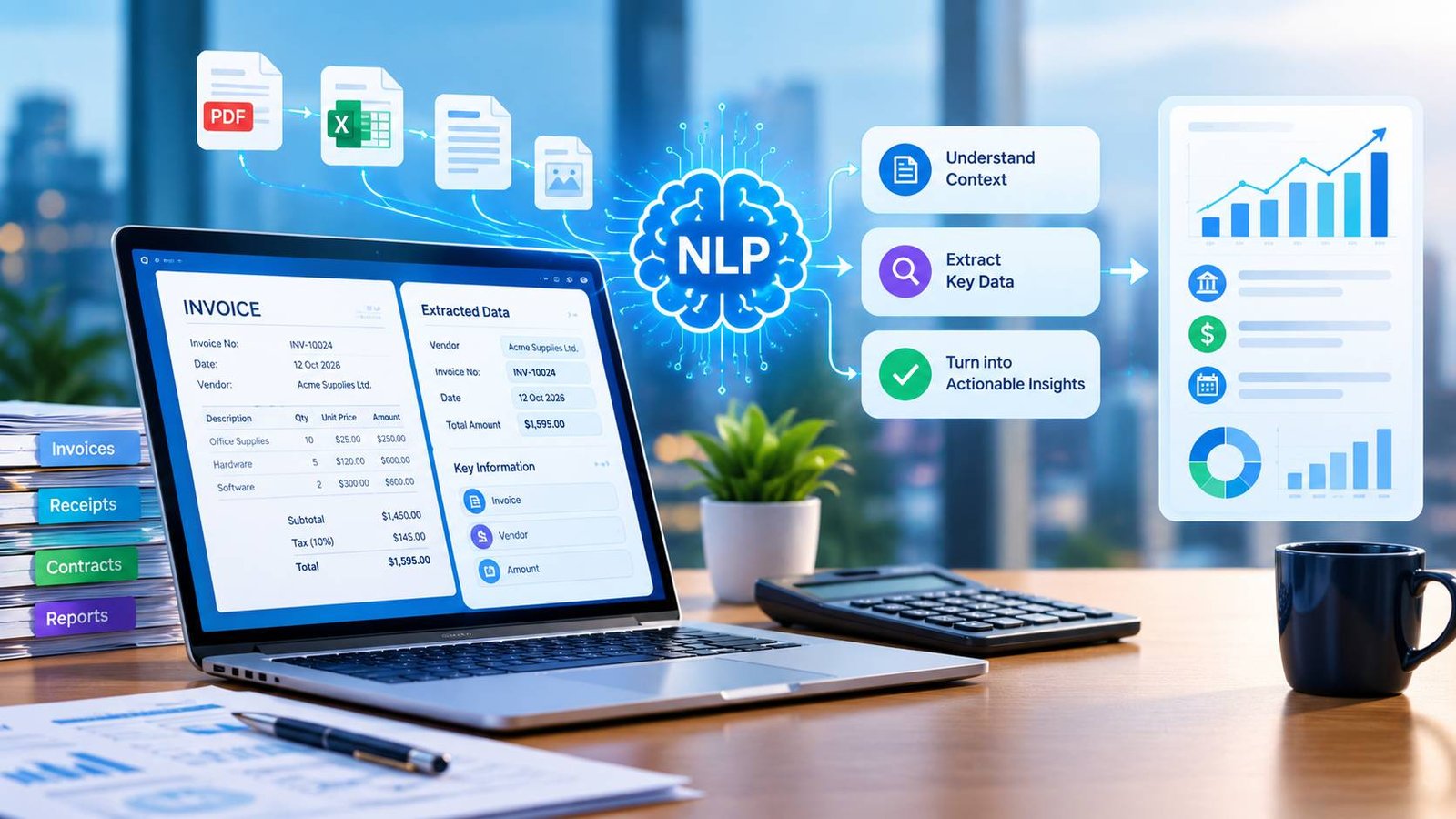
Finance professionals spend a remarkable share of their working lives reading. Annual reports, earnings call transcripts, loan agreements, prospectuses, regulatory filings, credit memos, research notes, board packs and audit files all contain decisions waiting to be made, if someone can find the right paragraph in time. NLP financial document analysis uses natural language processing to read, extract, compare, summarise and question these documents at a speed and scale no team can match.
This is different from basic data extraction. Pulling a total from an invoice is useful, but financial analysis often depends on meaning: whether a covenant has changed, how management’s tone shifted between quarters, which risk factors are new, whether a contract contains an unusual clause, or what a regulator’s new guidance means for a specific product. Modern NLP, particularly large language models combined with retrieval over trusted documents, can now handle much of that interpretive work, with people checking the results.
This guide is for CFOs, finance directors, heads of risk and compliance, investment and credit teams, CTOs and fintech founders in UK and US organisations. It explains how natural language processing is used in finance, the highest-value applications, how Morgan Stanley put 100,000 documents at its advisers’ fingertips, the accuracy and governance safeguards required and how to get started.
Why Financial Documents Are Hard for Traditional Tools
- Length and density. A single annual report or credit agreement can run to hundreds of pages.
- Specialist language. Terms such as “material adverse change”, “EBITDA add-backs” or “going concern” carry precise meanings.
- Mixed formats. Text, tables, footnotes and charts must be read together.
- Subtle changes matter. A single altered word in a covenant or risk disclosure can be significant.
- Volume. Analysts, credit officers and compliance teams face far more documents than they can read in full.
Keyword search and rules-based tools struggle with this complexity. Language models trained on financial and general text understand context, making them much better at interpreting meaning.
High-Value Applications of NLP in Finance
Financial Statement Analysis with AI
NLP extracts figures and narrative from annual reports and accounts, links notes to the numbers, compares periods and highlights changes in accounting policies, auditor comments or going concern statements.
Earnings Calls and Management Commentary
Text analytics can summarise earnings call transcripts, compare management tone and emphasis across quarters, and flag new topics or evasive answers to analyst questions.
NLP for Contract Analysis
Loan agreements, ISDA documentation, leases and supplier contracts can be analysed to extract key terms, compare against standard positions and flag unusual clauses, covenants and obligations.
NLP for Regulatory Filings and Compliance Monitoring
Firms must track a constant flow of regulatory publications, consultation papers and guidance. NLP can classify updates by relevance, summarise obligations and map them to internal policies and controls. It can also monitor communications for potential misconduct or mis-selling indicators.
Credit and NLP Risk Assessment
Credit teams use NLP to review borrower documents, news, filings and adverse media, summarising risk factors and supporting faster, more consistent credit memos.
Automated Financial Reporting
Language models can draft commentary for management accounts, board packs and investor reports from underlying data, with finance teams reviewing and approving the narrative.
Research and Knowledge Retrieval
Investment firms and banks hold vast libraries of internal research. NLP-powered assistants let professionals ask questions in plain English and receive sourced answers drawn from that knowledge.
Priorities by Organisation Type
- Banks and lenders: credit document review, covenant monitoring, complaints analysis and regulatory change management.
- Asset and wealth managers: research retrieval, earnings analysis, ESG report analysis and client meeting summaries.
- Insurers: policy wording comparison, claims correspondence analysis and regulatory reporting.
- Corporate finance teams: contract obligations, audit preparation, board reporting and supplier risk.
- Accountancy firms: audit evidence review, tax document analysis and client onboarding.
Each group shares the same foundations of document parsing, retrieval and verification, so a well-designed platform can support several use cases over time.
How Modern Financial NLP Works
- Ingestion and parsing. Documents are converted into machine-readable text, preserving tables, headings and structure.
- Chunking and indexing. Content is split into sections and indexed for semantic search.
- Retrieval. When a user asks a question, the system finds the most relevant passages across the document set.
- Analysis and generation. A language model interprets the retrieved passages to answer, summarise, compare or extract.
- Citation. Answers link back to source pages so users can verify every point.
- Validation. Numbers are cross-checked against structured data, and business rules flag inconsistencies.
This retrieval-augmented approach keeps answers grounded in your documents rather than the model’s general knowledge, which is essential in finance.
Real Business Example: Morgan Stanley’s AI Assistants
The challenge. Morgan Stanley’s wealth management division holds a huge body of internal research, investment strategy and process documentation. Its financial advisers needed fast, reliable answers to client questions, but finding the right information across the firm’s knowledge base took time.
The solution. Working with OpenAI, Morgan Stanley built AI @ Morgan Stanley Assistant, an internal tool based on GPT-4 that lets advisers ask questions in natural language and receive answers drawn from the firm’s own documents.
Implementation. The firm took an evaluation-led approach, testing the system rigorously against expert-reviewed answers before and during rollout, starting with a pilot group of advisers. It later added AI @ Morgan Stanley Debrief, which summarises client meetings (with client consent), drafts follow-up emails and adds notes to the CRM for advisers to review. For its institutional securities business, it introduced AskResearchGPT to help staff query the firm’s research.
Business outcome. According to OpenAI’s case study, Morgan Stanley moved from being able to answer around 7,000 questions to effectively answering any question from a corpus of 100,000 documents. Adoption among advisor teams has been widely reported at around 98%.
The key lessons: ground the model in trusted internal content, evaluate relentlessly against expert judgement, start with a pilot group and keep professionals reviewing outputs before they reach clients.
Accuracy, Governance and Regulation
Financial services is heavily regulated, and errors in analysis can lead to poor decisions, client harm or regulatory breaches. Essential safeguards include:
| Safeguard | Why it matters |
|---|---|
| Source citation for every answer | Lets users verify claims and supports audit |
| Numerical cross-checks | Language models can misread or miscalculate figures |
| Human review of material outputs | Professionals remain accountable for decisions |
| Evaluation test sets | Measures accuracy before release and after every change |
| Access controls | Ensures users see only documents they are entitled to, including information barriers |
| Model risk management | Documentation, validation and monitoring in line with regulatory expectations such as the PRA’s model risk principles |
| Data protection | UK GDPR compliance for client and employee data |
IIH Global’s AI security and governance services help financial institutions design these controls into document analysis systems from the start.
Data Sources and Integration
Financial NLP is only as good as the documents it can reach. Typical sources include:
- Public filings: annual reports, accounts filed at Companies House, regulatory announcements and prospectuses
- Market information: earnings call transcripts, broker research and news feeds, subject to licence terms
- Internal documents: credit files, loan agreements, board papers, policies and research
- Regulatory publications: rules, guidance, consultation papers and enforcement notices
- Structured data: general ledger, risk systems and market data used to cross-check extracted figures
Integration with document management systems, data warehouses and workflow tools lets insights flow into credit decisions, compliance registers and reporting rather than sitting in a separate application. Permissions must follow the documents: if a user cannot open a file directly, the AI assistant should not reveal its contents either.
For organisations with fragmented document stores, consolidating and indexing content is often the first and most valuable step, because it benefits every later use case.
Common Mistakes to Avoid
- Trusting generated numbers. Always reconcile figures with structured sources.
- Using public chatbots for confidential documents. Use enterprise deployments with appropriate data protection terms.
- Skipping evaluation. Without a test set of expert-checked answers, you cannot measure accuracy.
- Ignoring document quality. Poor scans and complex tables need proper parsing before analysis.
- Automating decisions rather than supporting them. Credit, investment and compliance judgements should stay with accountable professionals.
Getting Started
- Identify a document-heavy process with measurable pain, such as covenant monitoring, regulatory horizon scanning or research retrieval.
- Assemble a representative document set and questions experts need answered.
- Build a pilot with retrieval, citations and an evaluation framework.
- Test with a small expert group and measure time saved and accuracy.
- Add governance controls and integrate with existing systems before scaling.
Our natural language processing services build financial NLP tools tailored to your documents, workflows and compliance requirements.
Measuring Value
- Time to insight: hours saved per report, contract or filing reviewed
- Coverage: share of documents analysed rather than sampled
- Accuracy: agreement with expert review on test sets
- Risk detection: issues identified earlier, such as covenant breaches or regulatory changes
- Adoption: active users and repeat use, the clearest sign that a tool is genuinely helpful
The Future of Language Models in Finance
Financial NLP is moving from answering questions towards completing tasks: drafting credit memos, preparing compliance reports, reconciling documents against data and monitoring portfolios for emerging risks. Multimodal models are improving table and chart understanding. Domain-adapted models are getting better at specialist terminology. Regulators, including the FCA and the Bank of England, continue to examine how firms use AI, so strong governance will remain a competitive advantage rather than a burden.
Conclusion
NLP financial document analysis helps finance teams read more, faster and more consistently, turning dense documents into sourced insight. Morgan Stanley’s experience shows the value of grounding models in trusted content, evaluating carefully and keeping professionals in control. With citations, numerical checks and sound governance, NLP can become a dependable part of financial analysis.
To discuss NLP for your financial documents, talk to IIH Global.
Published by AiWebSoft.