

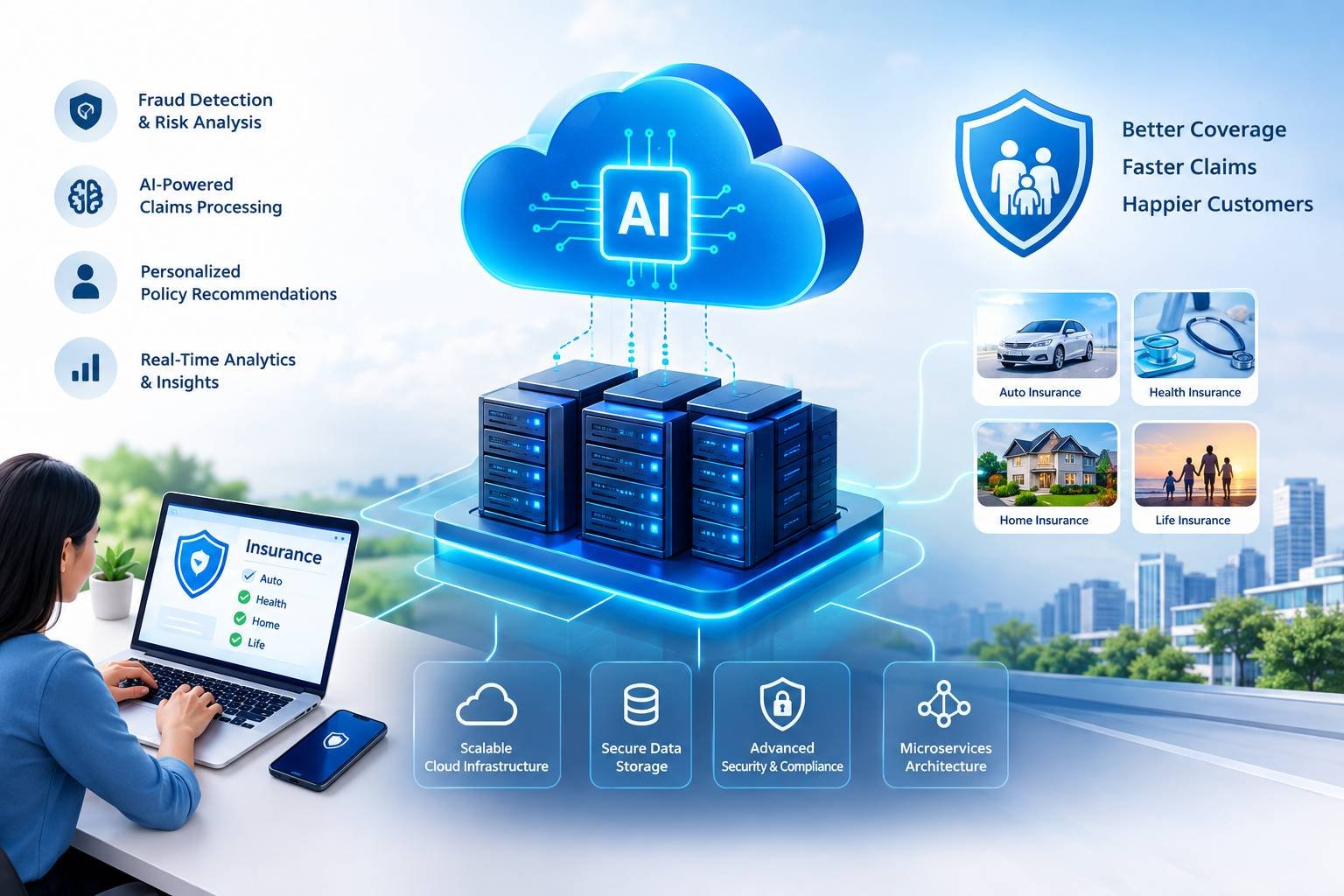
Insurance runs on data and decisions. Underwriters price risk, claims teams decide what to pay and fraud analysts look for patterns that do not add up. AI now supports all three, scoring applications in seconds, reading claim photos and documents and spotting suspicious activity across millions of policies. But many US insurers still run core systems built decades ago, which makes adding AI slow and fragile.
A modern cloud server architecture is what connects AI models to policy, billing and claims data safely and at scale. It has to handle sensitive personal data, meet state regulations, explain decisions to regulators and stay available during catastrophe events when claims spike overnight. At CRECSO, we help insurers, MGAs and insurtech startups design platforms where AI and legacy systems work together instead of against each other.
In this guide, you will learn the core layers of a cloud server architecture for AI insurance platforms, how regulation affects design, how Lemonade built AI-first claims handling, common mistakes and a practical plan for modernizing.
Where AI Adds Value in Insurance
- Underwriting: Faster risk scoring using third-party and internal data.
- Claims intake: Reading photos, documents and descriptions automatically.
- Fraud detection: Flagging unusual patterns across claims and providers.
- Customer service: Chat assistants answering policy questions 24/7.
- Pricing: More granular, data-driven rate models where regulation allows.
Core Layers of Cloud Server Architecture for AI Insurance Platforms
Most successful platforms share six layers.
1. Integration Layer
APIs and event streams connect the cloud to policy administration, billing and claims systems, including older on-premises cores. This lets AI read and write data without a full core replacement.
2. Data Platform
A cloud data lake or warehouse combines policy, claims, telematics and third-party data. Strong governance controls who sees what.
3. Model Serving and Decision Engine
Models score risk or claims in real time, while a decision engine applies business rules and limits. Keep AI recommendations separate from final actions where regulation requires human review.
4. Document and Image AI
Pipelines process claim photos, medical bills and repair estimates using OCR and vision models.
5. Governance and Explainability
Track every model version, input and decision. Many states have adopted the NAIC model bulletin on insurers’ use of AI, which expects documented governance and testing for unfair discrimination.
| Layer | Common Tools | Main Goal |
|---|---|---|
| Integration | API gateways, Kafka | Connect legacy cores |
| Data | Snowflake, Databricks, cloud warehouses | Single trusted view |
| Decisions | Model endpoints, rules engines | Fast, consistent outcomes |
| Documents | OCR, vision models | Automate intake |
| Governance | Model registry, audit logs | Regulatory compliance |
6. Surge Capacity for Catastrophes
A hurricane in Florida or wildfires in California can multiply claim volume within hours. Your cloud server architecture should autoscale intake, document processing and fraud scoring, with queues that absorb spikes and clear priorities for urgent claims. Test this before storm season, not during it.
AWS outlines similar building blocks for carriers on its insurance industry page. Our insurance software development team applies them to real carrier systems.
Real Business Example: Lemonade’s AI-First Claims
Business challenge: Traditional claims handling is slow and paperwork-heavy, which frustrates customers and raises costs.
Solution: Lemonade, a New York-based insurer, built its platform around AI from the start, with an AI claims assistant handling first notice of loss through a chat app.
Implementation: Customers describe the claim, the system runs fraud and policy checks automatically and simple claims can be paid without human review. Complex cases go to human adjusters.
Outcome: Lemonade famously reported settling a claim in a matter of seconds back in 2016 and has said that a significant share of claims are now handled instantly.
Business impact: Speed became a brand advantage. Lemonade also faced public criticism in 2021 over how it described AI in claims and clarified that AI does not automatically reject claims, a reminder that transparency matters as much as automation.
Pros and Cons of Cloud AI Architecture for Insurers
| Pros | Cons |
|---|---|
| Faster quotes and claims | Legacy integration takes time and budget |
| Elastic capacity during catastrophe events | State regulations vary and keep changing |
| Better fraud detection across data sets | Bias and explainability risks need constant testing |
Best Practices
- Wrap legacy cores with APIs before replacing them, so your cloud server architecture can grow around them.
- Keep humans in the loop for claim denials and adverse decisions.
- Test models regularly for unfair discrimination.
- Plan capacity for catastrophe-driven claim surges.
- Encrypt and tokenize personal data across the platform.
Finance teams inside insurers can find related use cases on AI for finance.
Common Mistakes to Avoid
- Trying to replace the entire core system before adding any AI.
- Letting AI deny claims without human review.
- Ignoring state-by-state AI and data rules.
- Sizing systems for normal weeks, not hurricane season.
How to Get Started
- Pick one high-volume process, such as simple auto or property claims.
- Build API access to the needed policy and claims data.
- Set up a governed data platform and model registry within your cloud server architecture.
- Pilot AI recommendations with adjuster review.
- Measure cycle time, accuracy and customer satisfaction before scaling.
Insurance AI architecture checklist:
- ☐ Legacy integration APIs in place
- ☐ AI governance program documented
- ☐ Bias testing scheduled
- ☐ Catastrophe surge plan tested
- ☐ Human review for adverse decisions
Insurers moving older workloads off mainframes can use our cloud migration services.
Future Trends
Expect AI agents handling routine claims end to end, more use of telematics and IoT data, and tighter state rules on AI use in underwriting. Cloud server architecture will increasingly include built-in explainability and fairness testing.
Key Takeaways
- Insurance AI needs integration, governed data, decision engines and audit trails.
- A sound cloud server architecture connects AI to legacy cores safely.
- Human review and transparency protect customers and reputation.
Conclusion
A strong cloud server architecture lets insurers add AI to underwriting, claims and fraud work without risking compliance or customer trust. Integration first, governed data and clear human oversight are the foundations. CRECSO helps US insurers and insurtechs design and build AI-ready cloud platforms. Planning your modernization? Talk to our cloud engineering team.